
What is a 3 Tesla MRI?
A 3 Tesla MRI is a scanner with a magnetic field strength of 3.0 Tesla, double that of a standard 1.5T system. The stronger field produces roughly twice the signal, which the scanner uses for finer detail, a shorter scan, or both.
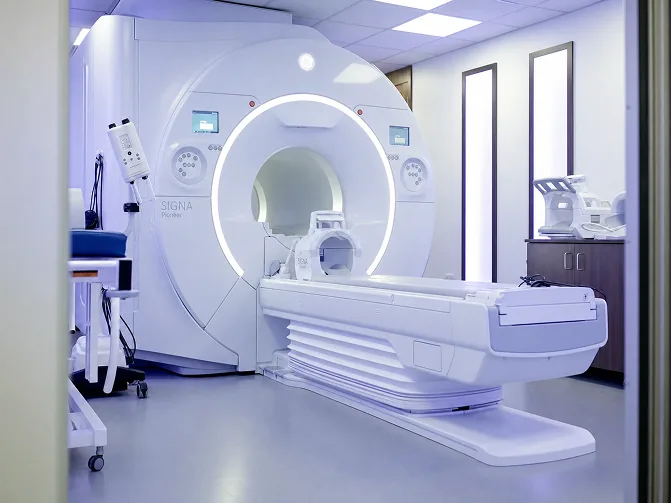
This page explains the technology. Ready to book a 3T MRI?
See our 3 Tesla MRI service pageHow field strength works.
MRI works by aligning the hydrogen protons in your body inside a magnetic field, nudging them with a radio pulse, and reading the faint signal they return as they settle. A stronger magnet aligns more protons, so more of them contribute to that returning signal.
More signal relative to background noise, the signal-to-noise ratio, is what lets a radiologist tell a real 3 mm finding apart from grain in the image. At 3 Tesla we can spend that extra signal on thinner slices, a shorter scan, or a balance of the two.
1.5T vs 3T.
Which exams benefit from 3 Tesla.
Brain MRI
Sharper gray-white differentiation for small lesions and MS plaques.
View examSpine MRI
Finer nerve-root and disc detail without stretching scan time.
View examJoint MRI
Thin-slice cartilage, labrum and ligament imaging in high resolution.
View examBreast MRI
High-contrast dynamic imaging for high-risk screening and staging.
View examCardiac MRI
Better tissue characterization of myocardium and scar.
View examWhole Body MRI
More signal to cover more anatomy in a tolerable single session.
View examHonest limitations.
Not better for every study
Some body and lung imaging behaves better at 1.5T, where susceptibility effects are milder and coverage is more forgiving.
Artefact considerations
Higher field strength amplifies susceptibility and chemical-shift artefacts, especially near metal hardware or air-tissue boundaries.
Implant safety
Some devices are labelled MR-conditional at 1.5T only, and a few patients should not have MRI at all. Screening happens before scheduling.
Our radiologists select the right modality and field strength for each case, and tell you plainly when a different exam is the better answer.
No radiation, at any field strength.
MRI uses magnetism and radio waves, not ionizing radiation, so there is no radiation dose to consider at 1.5T or 3T. What does matter is metal: every patient completes a safety screening for implants, pacemakers, neurostimulators, surgical clips and occupational metal fragments before entering the magnet room. Bring device cards or implant documentation to your visit, it is the fastest way to confirm you can be scanned safely.