
The imaging technology behind every scan
Lucent Medical Imaging in Glendale operates 3 Tesla MRI with AI-enabled reconstruction, low-dose CT protocols, 3D tomosynthesis mammography and Sonocine automated breast ultrasound, current-generation equipment usually found at major academic centers.
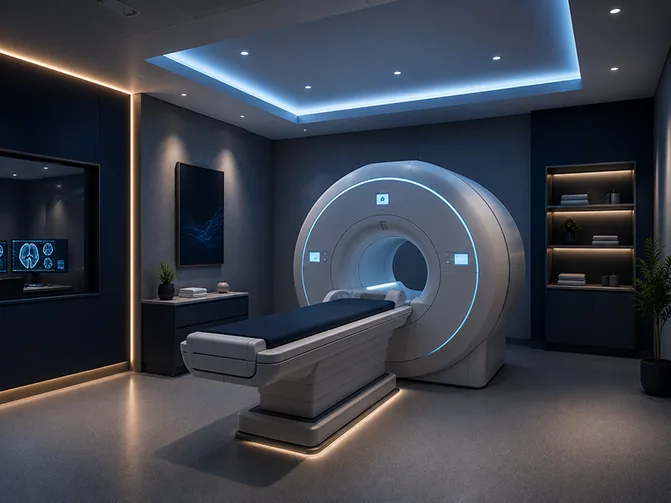
Not all imaging is the same.
The same exam name can mean very different image quality. A “knee MRI” at one center and a “knee MRI” at another can differ in field strength, coil design, sequence protocol and slice thickness, and those differences decide how much detail reaches the radiologist.
Field strength, reconstruction software and radiologist subspecialty all affect whether a small finding is seen or missed. That is why we publish exactly what we run, and why we will tell you when a different modality would answer your question better.
The equipment we run at Lucent.
3 Tesla MRI
Double the field strength of a standard 1.5T scanner.
- 3.0 Tesla magnet
- Finer small-lesion detail
- Often shorter scan times
AI-Enabled GE Hero MRI
Deep-learning reconstruction for sharper images in less time.
- Deep-learning reconstruction
- Lower image noise
- Radiologist-interpreted
Sonocine Automated Breast Ultrasound
Whole-breast automated screening for dense tissue.
- Whole-breast coverage
- No radiation, no compression
- Reproducible image set
Beyond MRI.
Better equipment, in plain terms.
Smaller findings seen earlier
More signal and thinner slices mean a small lesion is more likely to be resolved rather than averaged away.
Shorter time on the table
Faster sequences and AI reconstruction let us shorten many exams without giving up image quality.
Fewer repeat scans
Cleaner first-pass images and better motion tolerance reduce the need to call you back for a redo.
Confident subspecialty reads
Better data in front of a fellowship-trained radiologist produces a clearer, more decisive report.
Built for the people reading our reports.
- Subspecialty reads by fellowship-trained radiologists
- Structured, protocol-consistent reporting
- 24-48 hour standard turnaround
- Images delivered to your preferred channel
- Direct radiologist access for questions
Better equipment isn’t everything.
Technology only matters alongside correct protocol selection, careful positioning and an experienced radiologist. A perfectly maintained 3T scanner still produces a weak study if the wrong sequence is run or the patient is positioned poorly.
Higher field strength is not automatically better for every exam, some studies are better at 1.5T, and some questions are answered faster with diagnostic ultrasound or a CT scan instead. If that is the case for you, we will say so.