01
Shorter scans
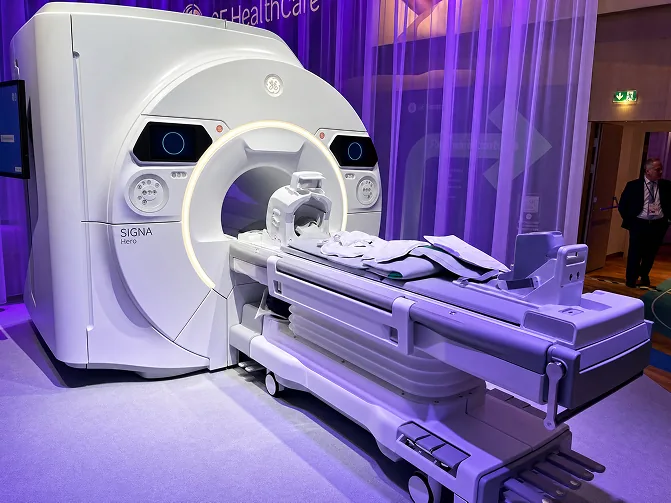
Fewer measurements to acquire means less time in the bore, a real difference for patients with pain or claustrophobia.

AI-enabled MRI uses deep-learning reconstruction to build a clean, detailed image from fewer measurements, producing sharper scans in less time. At Lucent, the AI assists the image; a board-certified radiologist interprets it.
This page explains the technology. Ready to book?
See our MRI service pagesA conventional MRI builds an image from a full raw data set. Collecting every one of those measurements is what makes a scan long, and if the acquisition is shortened, the image gets noisier.
Deep-learning reconstruction, trained on large volumes of high-quality imaging data, has learned what clean MRI data looks like. It can therefore reconstruct a sharp, low-noise image from fewer measurements, a little like a skilled restorer who knows the grain of the material well enough to resolve detail without inventing it. The scan is shorter and quieter; the anatomy on screen is still yours.
Fewer measurements to acquire means less time in the bore, a real difference for patients with pain or claustrophobia.
Reconstruction suppresses noise rather than blurring it away, so fine structures keep their edges.
Cleaner first-pass images reduce the number of sequences that have to be re-run before the study is diagnostic.
Shorter sequences are easier to hold still through, which matters most for chest, abdomen and paediatric imaging.
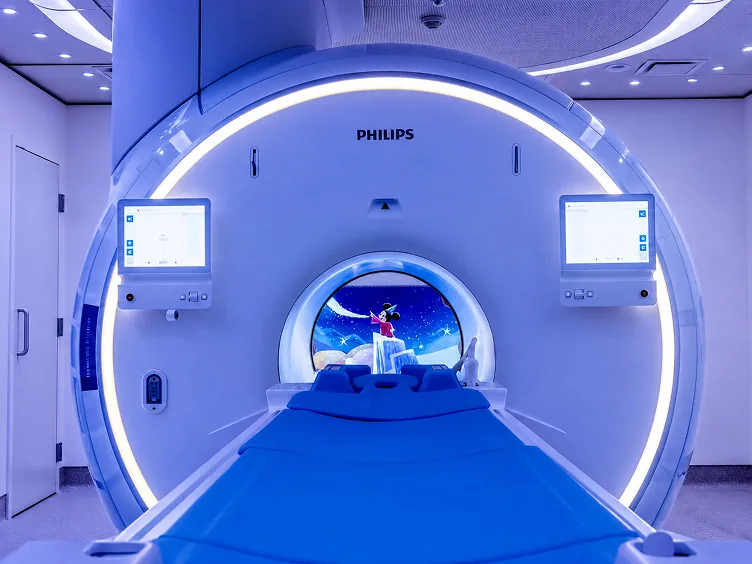
Every study at Lucent is interpreted by a board-certified, fellowship-trained radiologist who is accountable for the read.
We adopt what is clinically validated, not what is merely new. We are transparent about where AI touches your exam, reconstruction, noise, scheduling efficiency, and we keep a human radiologist accountable for every interpretation. If a tool cannot demonstrate it improves care, it does not run on your scan.